
Building an AI coach for leaders takes a day; making it useful takes five more steps
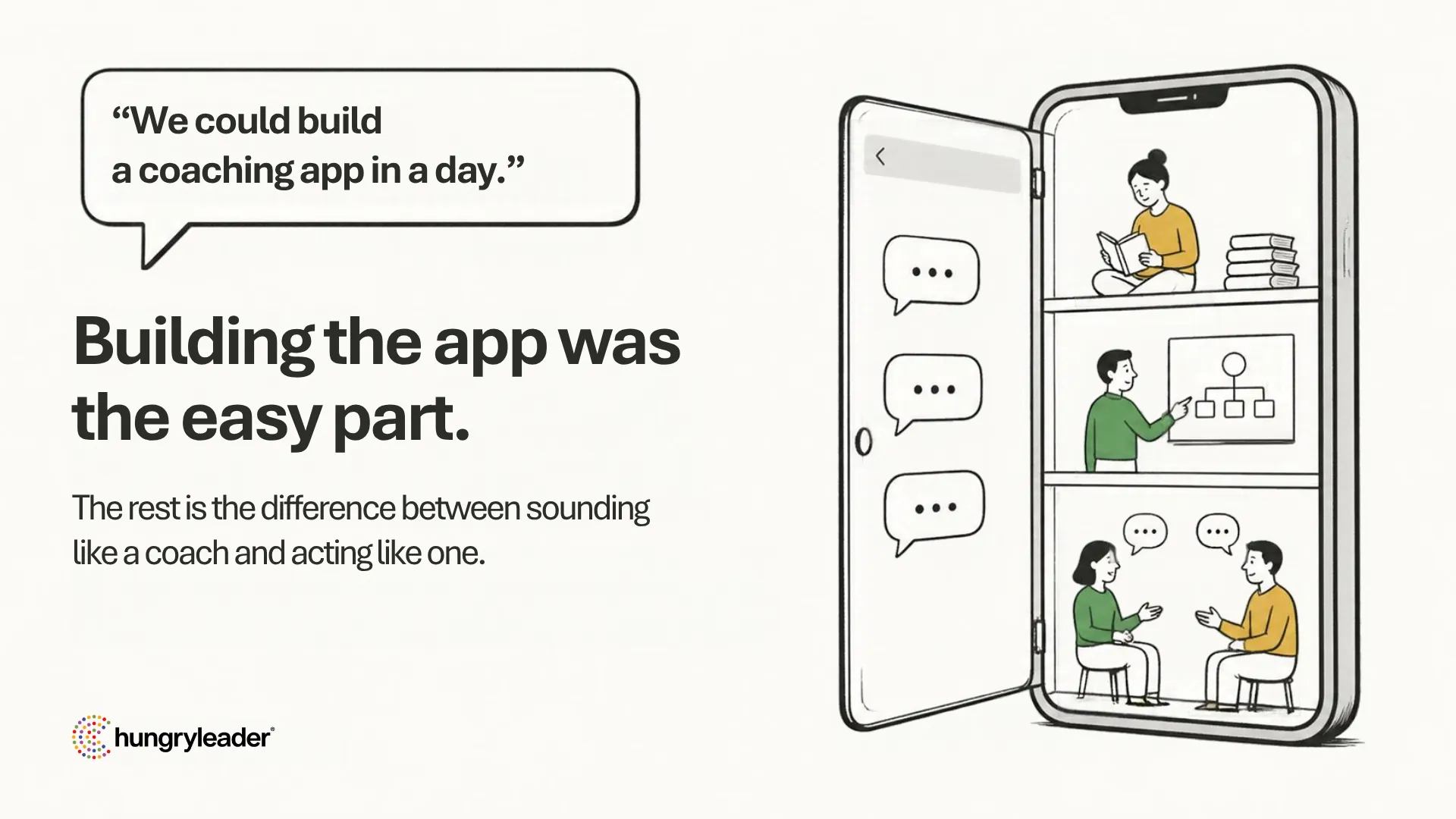
At a recent client meeting, someone told us that their team could build a coaching app in a day, and they were right. With a large language model, a chat window, and a well-chosen name, almost any capable team could have something that sounds like a coach by lunchtime. Building the app, however, is only the first of six steps. It’s also the easiest one; the remaining five determine whether an AI performance coach changes anything for leaders and their teams.
If you lead HR or L&D and are wondering whether to build your own AI coach, here is the full to-do list. For each step, we’ve included what tends to happen and how we handled it when building Klaro™ at hungryleader®.
Step 1: Build a coaching app in a day
What it takes: A large language model, a chat window, a fun name, and a system prompt that tells the model to behave like a coach.
What tends to happen: By lunchtime it sounds like a coach, and by mid-afternoon it can also sound like a management consultant, a motivational poster or, if asked nicely, a pirate.
That’s because it’s built to please. The real question: is it designed to help a leader navigate their next tough conversation? In a hotel or healthcare setting, this needs to happen mid-shift with less than ten minutes to prepare.
What we did: We started with the app, and the five steps that follow show the work it took to turn it into a coach that changes how leaders act.
Step 2: Teach it to coach rather than instruct
What it takes: A coaching framework that asks instead of advising and lets leaders work through the problem themselves.
What tends to happen: Ask a generic model how to handle an underperforming sous-chef, and it will produce a seven-point plan with bold headings before you have finished describing the problem. The plan is confident, occasionally sensible, and somebody else’s entirely.
Handing your thinking to a machine feels efficient, but it sidelines what leaders bring that no AI model has: lived experience of leading, lessons learned the hard way, and memories of what worked and what didn’t. They can work through complex emotions and reach insights that change how they lead. They don’t need a script or to be told what to do. They need help focusing under pressure, when their skills, knowledge, and experience are put to the test.
What we did: Klaro is built on the ICF’s AI coaching framework, which we’ve adapted with our years of experience in coaching and leadership learning. It asks before it challenges and never scripts what a leader should say, so the commitment they leave with is one they created. This is the core of AI leadership coaching done ethically, and it is also the hardest part to get right.
Step 3: Close the rabbit holes
What it takes: A closed, curated library of behavioral science research in place of the open web. Browsing and uploads are switched off, and conversations are designed to stay focused, like a real coaching session.
What tends to happen: A restaurant manager has ten minutes before a check-in with a server who keeps arriving late. With no support available in the moment, they turn to whatever a quick search brings up: a leadership blog, a forum thread, a viral post. They end up with more advice, none of it vetted, and no clearer idea of what to say.
What we did: We built these limits into Klaro from the start. Its research library is overseen by our lead researcher, a behavioral scientist and organizational management practitioner, so the strategies it draws on come from research rather than whatever ranks highest online. Keeping each conversation on the one issue a leader arrives with helps their attention and energy go back to the people they lead.
Step 4: Teach it when to hand over to a human
What it takes: Clear limits on therapy, counseling, and HR decisions. A clear route to the right professional support and plenty of testing to ensure those limits hold.
What tends to happen: When a manager needs to let a team member go, they may ask an all-purpose model to tell them how to do it, even though its answer may not match the advice HR would give them.
What we did: When a conversation goes beyond coaching, Klaro says so and points the leader to HR, counseling, or other professional support. We built these guardrails because some situations call for HR, legal, or clinical expertise, not coaching. Klaro is also designed to meet the requirements of the EU AI Act.
Step 5: Get leaders ready for the real conversation, then step aside
What it takes: A coaching flow that prepares leaders for conversations with their team, peers, or manager, then sends them off to have those conversations instead of keeping them talking to the app.
What tends to happen: A head chef needs to talk to a line cook who keeps snapping at new staff during service. She talks it through with a chatbot on Monday, again on Tuesday, and once more on Thursday. Each session feels like progress, but by Friday the conversation still hasn’t happened. The chatbot has quietly taken the place of the action, and of the colleague she might otherwise have asked for help.
What we did: Klaro helps leaders prepare the way a good coach would: clarifying what they want from the conversation, challenging their thinking, surfacing the assumptions and blind spots they might bring into the room, and finding new ways to look at the problem. The session ends when the leader has crafted their next step and decided when they’ll take it. Then Klaro gets out of the way.
This matters commercially, too. Conversations about feedback, performance, and conflict that are put off can resurface later as costlier HR cases, which is why Klaro is built to get leaders into them sooner.
Step 6: Stop counting logins and start measuring behavior change
What it takes: A way to measure whether leaders actually act differently, and people who keep tuning the coach as the results come in.
What tends to happen: Within a month, the dashboard shows impressive usage, and the quarterly report celebrates AI adoption, yet nobody can say whether a single difficult conversation went better.
What we did: We designed our own methodology for measuring behavior change, so leaders and organizations can see the habits they have today and whether more productive ones are taking hold. The evidence we look for is leaders raising tough conversations sooner and their teams getting feedback more often. A small team, led by our educational technologist, reviews the results and keeps refining Klaro.
Should you build or buy an AI coach?
Looking back at the list, the one-day project now includes an adapted coaching framework, a curated behavioral science library, guardrails for therapy, counseling, and HR decisions, alignment with the EU AI Act, a coaching flow that gets leaders into real conversations, a way to measure behavior change, and a permanent team to keep improving it. That is a realistic project for an organization with a year or more to invest, and behavioral scientists, coaches, and educational technologists free to work on it full time. Most HR and L&D teams we meet are already stretched trying to support their leaders, and a coaching app built from scratch would compete for the same time and budget.
Klaro™, hungryleader®’s leadership and performance AI coach, has all six steps built in. It was created by experienced practitioners who have watched leadership programs fall short when leaders get back to work, and the hard conversation arrives. That moment is where AI in leadership development earns its place.
You could build it in a day, or you could start with all six steps already done and ready to be white-labeled for your organization.
Want to see how Klaro™ works with your own leaders before deciding? Send us a message here on LinkedIn, and we’ll shape a small pilot around the conversations your leaders find hardest.